How an interpreting chain works
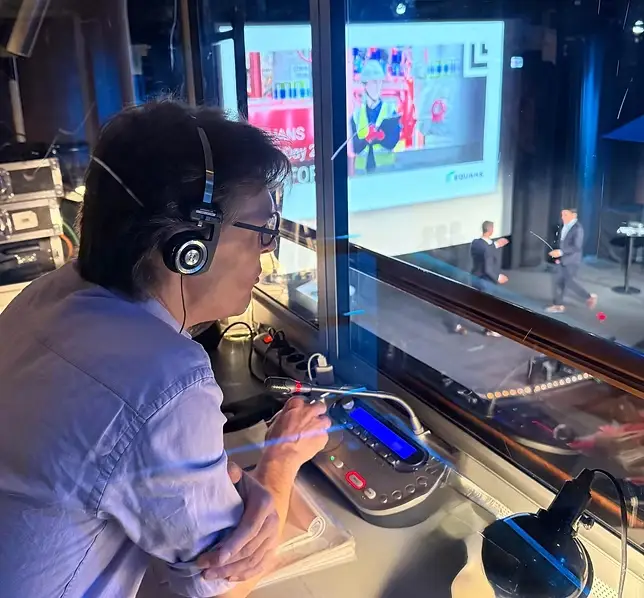
The speaker's microphone sends sound to the interpreter's console inside a soundproof booth. The interpreter speaks into their own microphone; their voice is broadcast on a radio or infrared channel, which each participant picks up with a receiver and headset. One language equals one channel.
Any weak link shows immediately: a badly placed speaker microphone makes interpreting approximate, a poorly insulated booth creates interference, an uncharged receiver dies mid-session. That is why we test everything beforehand.
ISO standards
Two international standards apply: ISO 2603 for permanent booths and ISO 4043 for mobile ones. They cover four essentials: working space for two interpreters, continuous silent ventilation, acoustic insulation in both directions, and a clear view of the speaker and screen.
These are not comfort requirements. Poor ventilation raises CO₂ levels and measurably reduces alertness; no line of sight means the interpreter cannot read lips or follow slides. Our mobile booths comply with ISO 4043 and certificates are available on request.
What we supply
- Mobile and permanent soundproof booths
- Two-position interpreter consoles (Bosch, Televic, Sennheiser)
- Headsets and multichannel receivers
- Infrared systems for confidential meetings
- Conference microphones: gooseneck, lavalier, headset, handheld, discussion systems
- Tour-guide systems for site visits and mobile groups
- Sound reinforcement and technical control
Pricing
| Item | Per day |
|---|---|
| Mobile booth + 2-position console | Main technical item |
| Additional booth | One per target language, sliding scale |
| Receiver + headset | Per unit per day, sliding scale above 100 |
| Tour-guide system (up to 30 people) | Several times less than a booth |
| On-site technician | Fixed whenever a booth is used |