Our approach to pricing
We never start from a catalogue. We start from your event: how many people genuinely need translation, during which sessions, in which languages, and at what level of stakes.
This regularly leads to lighter proposals than initially envisaged. We often recommend a tour-guide system where four booths were planned, translating only part of the programme, or moving a meeting online. A client who spends less and gets what they wanted comes back.
Conversely, we decline configurations that would look economical but produce a poor result — a single interpreter for a full day of simultaneous, for instance. Quality would collapse by the afternoon, and our name would be on it.
Self-service AI solution: our public rates
This is the only configuration we price publicly, because it is fully standardised: your participants scan a QR code, choose their language and follow the conference as subtitles on their own phone. No app to install, no receivers to hand out.
| 3-hour package | 8-hour package | |
|---|---|---|
| Two languagesfor example English – French | €399.99 excl. VAT | €599.99 excl. VAT |
| Each additional language | + €119.99 excl. VAT | + €239.99 excl. VAT |
Prices exclude VAT. For intermediate formats or specific configurations, we prepare a tailored proposal.
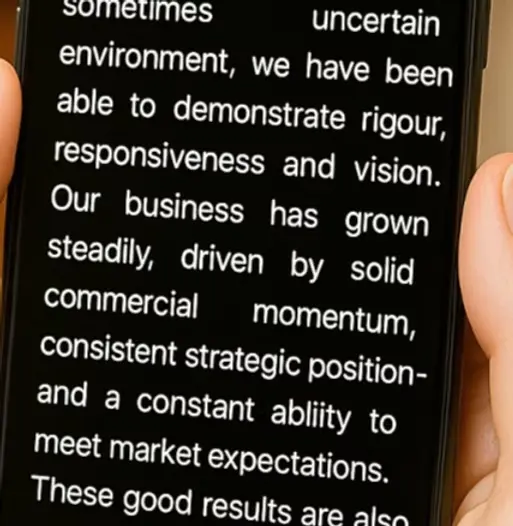
In real conditions — 16 seconds
Client feedback
“With participants from 9 nationalities, simultaneous translation was essential to make Ricardo Garcia's Setter Philosophy Conference accessible to everyone. Thanks to your expertise, the conference was translated seamlessly from Portuguese into English, French, and German. Simple, reliable, and incredibly effective.”
What this price includes: a ready-to-use solution that requires no preparation on your part. You receive your access links and QR code before the event; on the day, you simply display or project them, and your participants follow the conference in their own language within seconds. Nothing to install, nothing to configure, no documents to send us.
Would you like a glossary tailored to your industry or a page in your brand colours? These options are available on request.
We invite you to contact us to get to grips with this self-service setup: a few minutes' conversation will remove any hesitation on the day, and you will often discover uses you had not thought of.
Other configurations, on quotation
Display on a large screen. Showing subtitles in the room depends on your video equipment, the size of the room and the reading distance. These parameters are checked case by case.
Audio output of the translation. More demanding than subtitling: it requires a connection to the existing sound system and a technician on site. It is also the most comfortable configuration for a large audience.
On-site support. For high-stakes events, a technician present from set-up to dismantling.
In every case, call us: we will tell you frankly which configuration suits your event, including when a simpler solution is enough.
How time is counted
A conference interpreter is booked by the day, not by the hour. A two-hour meeting takes up their availability for the day, and above all it requires terminology preparation beforehand which is not billed separately but is very real.
That invisible work — reading the materials, building the glossary, researching the speakers and their field — is what separates fluent interpreting from laboured interpreting.
What makes up a budget
| Item | Nature |
|---|---|
| Interpreters | Fixed. The number depends on duration and number of languages. |
| Booths and consoles | Adjustable. Nil if the venue is already equipped, or if a lighter solution will do. |
| Receivers and headsets | Adjustable. Based on actual listeners, not total attendance. |
| Technician | Fixed whenever a booth is installed. |
| Transport and logistics | Adjustable. Varies with location and equipment volume. |
| Travel and accommodation | Adjustable. Reduced by using locally based interpreters. |
Every item appears separately on our quotes. You see what you are paying for and can remove anything you already have.
Mixing technical solutions: our main lever
This makes the sharpest difference to a budget, and it is rarely offered spontaneously. Nothing requires a whole event to be handled with a single setup.
Mixing human and AI. Human interpreters on the two or three strategic languages, AI subtitling on secondary ones where only a handful of people are concerned. On an eight-language congress the difference against eight booths is considerable, without degrading the experience of your main audiences.
Mixing infrared and radio frequency. Infrared for the confidential plenary, where the signal must not cross walls; cheaper RF for workshops where confidentiality is not at stake and participants move around.
Mixing booths and tour-guide systems. A booth for the plenary, portable systems for breakout workshops and site visits — one of the most cost-effective trade-offs on a corporate seminar.
Mixing formats. Simultaneous in plenary, consecutive for the official address, whispering for two foreign guests at dinner — often with the same interpreters.
Six optimisation levers
1. Translate only what needs translating. On a congress, cover the plenary and the sessions with a genuinely international audience, then subtitle specialist workshops whose audience is already English-speaking.
2. Choose an equipped venue. A convention centre with permanent booths removes an entire budget line. Factor this in when choosing the venue, not afterwards.
3. Move all or part of it online. Remote interpreting removes travel, accommodation and booths.
4. Calibrate the number of receivers. The classic mistake is one per attendee. In practice only a fraction listen to the translation.
5. Use local interpreters. We recruit in the event's region whenever the language combination allows.
6. Book early. The simplest and most effective lever. Urgency costs, and haste degrades preparation.
What makes a proposal vary
- Rarity of the language combination. The pool of Japanese, Korean or Greek conference interpreters bears no comparison with English or Spanish.
- Lead time. Rush requests mobilise resources under unfavourable conditions.
- Location. Distance, access constraints, heritage sites where nothing can be fixed to walls, customs formalities for Switzerland, the UK or Monaco.
- Season. March to June and September to November concentrate most events; major trade fairs absorb the entire regional pool.
- Existing venue equipment. Decisive, as noted above.
- Duration. Consecutive days benefit from a sliding scale.
- Interpreter status. AIIC members command higher terms. We always tell you the status of the profiles proposed so the trade-off remains yours.
Recording and broadcast: plan it at booking stage
Regularly discovered too late: an interpreter's performance is protected by copyright and neighbouring rights. It cannot be recorded, rebroadcast or included in a replay without their prior agreement.
That agreement is negotiated when the assignment is booked, never on the day. It usually involves additional remuneration, proportionate to the intended use: internal archive, replay for participants, or public broadcast.
If you are considering streaming, a multilingual replay or a transcript, say so with your quote request. We then include those rights in the proposal, avoiding a delicate negotiation the day before the event.
Getting a proposal
Six details are enough for a precise quote: the date and duration, the venue, the languages and dominant direction of exchange, the number of participants needing translation, the format, and the subject in a single sentence.
The quote is free, itemised, and normally reaches you within one working day. Pre-sales advice is free too and commits you to nothing: if we think a simpler solution will do, we will say so.